India’s fitness landscape is undergoing a remarkable transformation. Traditional ideas about exercise—where weightlifting was seen as a man’s domain and Pilates or flexibility training was considered primarily for women—are steadily fading. Today, fitness enthusiasts are making choices based on health goals, functionality, and long-term wellbeing rather than gender stereotypes.
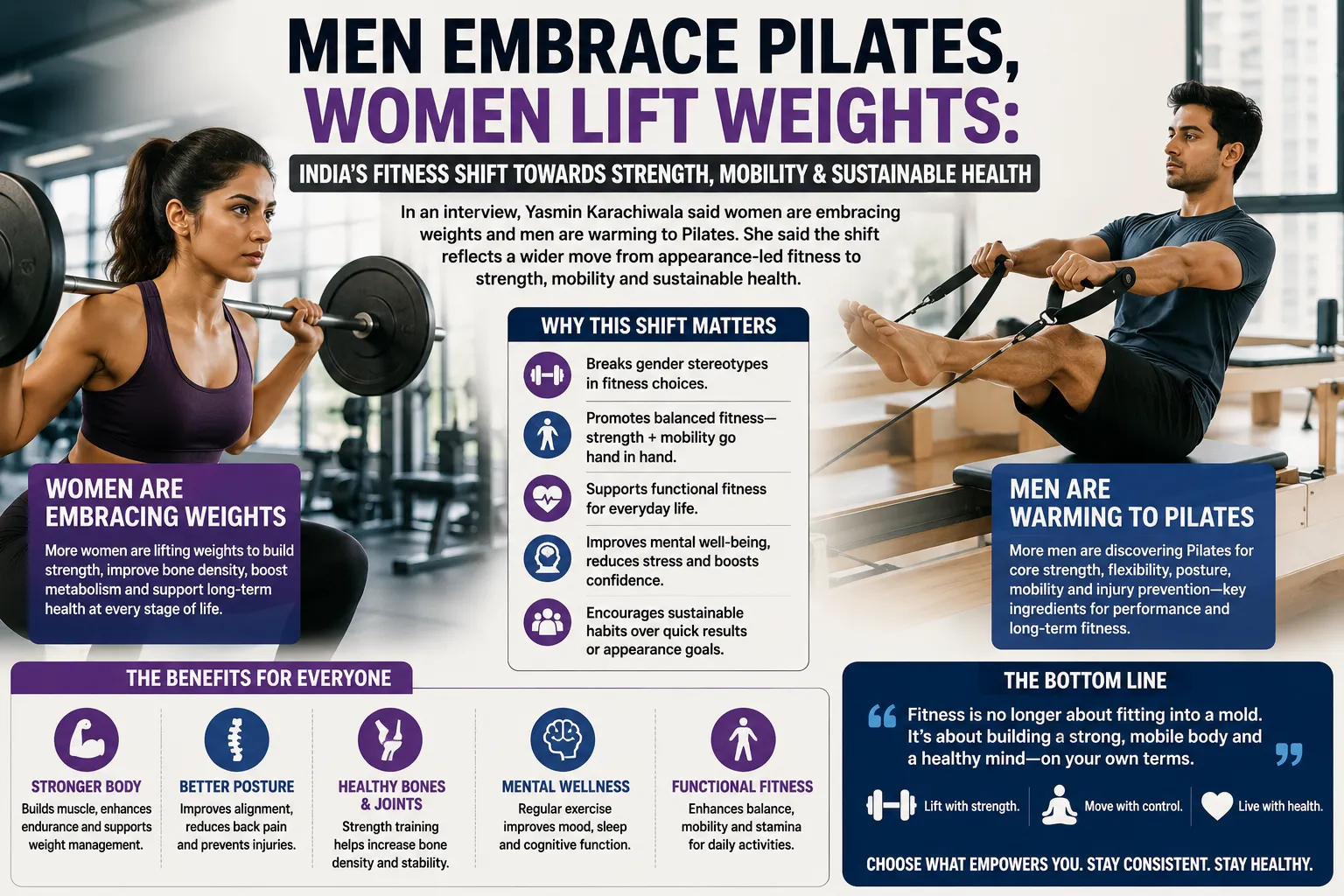
Celebrity fitness trainer Yasmin Karachiwala recently highlighted this changing trend, observing that more women are confidently incorporating strength training into their routines, while an increasing number of men are discovering the benefits of Pilates. According to her, this shift reflects a broader evolution in the way people approach fitness. Instead of focusing solely on appearance or weight loss, many Indians now prioritize strength, mobility, posture, injury prevention, and sustainable health.
The trend mirrors global developments in the fitness industry, where personalized exercise programmes are replacing one-size-fits-all workout routines. As scientific understanding of exercise continues to improve, both men and women are embracing training methods that deliver comprehensive physical and mental health benefits.
A New Era of Fitness in India
Fitness awareness has grown significantly across India over the past decade.
Earlier, gym culture often revolved around building visible muscles, losing weight quickly, or achieving a particular body shape. Exercise choices were frequently influenced by social expectations regarding masculinity and femininity.
Today, that mindset is changing.
People increasingly recognize that good health cannot be measured only by body weight or appearance. Functional movement, cardiovascular health, flexibility, muscular strength, endurance, recovery, and mental wellbeing have become equally important.
This broader understanding is encouraging individuals to explore different forms of exercise regardless of traditional gender associations.
Why Women Are Embracing Strength Training
One of the most noticeable shifts is the growing popularity of weight training among women.
For many years, misconceptions discouraged women from lifting weights. Some feared becoming excessively muscular, while others believed cardio alone was sufficient for fitness.
Modern exercise science has helped dispel these myths.
Strength training offers numerous health benefits for women throughout different stages of life.
It helps increase muscle strength, improves bone density, supports joint stability, enhances posture, boosts metabolism, and reduces the risk of age-related muscle loss.
Regular resistance training also contributes to better functional independence as people grow older.
Many women now view weightlifting not as bodybuilding but as an essential component of overall health.
Why More Men Are Choosing Pilates
At the same time, Pilates is attracting increasing interest among male fitness enthusiasts.
Originally developed by Joseph Pilates during the early twentieth century, Pilates focuses on controlled movements that improve core strength, flexibility, balance, posture, breathing, and body awareness.
Professional athletes across various sports have incorporated Pilates into their training programmes for many years.
Men are increasingly recognizing that flexibility and mobility are not signs of weakness but essential elements of athletic performance and injury prevention.
Improved core stability can enhance strength, running efficiency, lifting technique, and overall movement quality.
This growing awareness has expanded Pilates beyond its earlier perception as a niche workout.
Breaking Long-Standing Fitness Stereotypes
The changing fitness preferences reflect a wider cultural shift.
Exercise is becoming less about conforming to gender expectations and more about achieving individual health goals.
Women feel increasingly confident using free weights and resistance machines.
Men are becoming more comfortable participating in mobility classes, stretching sessions, and Pilates studios.
This evolution demonstrates that effective exercise is determined by physiological needs rather than outdated social assumptions.
Fitness professionals increasingly encourage clients to choose workouts based on personal objectives rather than stereotypes.
The Rise of Functional Fitness
Another major trend shaping India’s fitness culture is the growing popularity of functional training.
Unlike workouts focused solely on appearance, functional fitness prepares the body for everyday activities.
Exercises improve balance, coordination, flexibility, strength, and endurance through movements that resemble daily tasks.
Whether lifting groceries, climbing stairs, carrying children, or participating in recreational sports, functional fitness supports real-world movement.
Both strength training and Pilates contribute significantly to functional performance, making them complementary rather than competing exercise methods.
Strength and Mobility Go Hand in Hand
Experts increasingly emphasize that strength and mobility should develop together.
Strong muscles without adequate flexibility may increase movement limitations.
Similarly, excellent flexibility without sufficient muscular strength may reduce joint stability.
An ideal fitness programme combines resistance training with mobility exercises, stretching, balance work, and cardiovascular activity.
Pilates complements strength training by improving posture, movement control, breathing mechanics, and core stability.
Together, these approaches help create a more balanced level of physical fitness.
Mental Health Benefits of Modern Exercise
The evolving fitness culture also reflects greater awareness of mental wellbeing.
Regular physical activity has been associated with improved mood, reduced stress, better sleep quality, enhanced concentration, and increased self-confidence.
Strength training often provides a sense of accomplishment as individuals progressively improve their performance.
Pilates encourages mindful movement, controlled breathing, and body awareness, helping participants reduce stress while improving concentration.
The combination of physical and psychological benefits makes exercise an important component of overall wellness.
Social Media’s Influence on Fitness
Digital platforms have played an important role in changing fitness perceptions.
Certified trainers, physiotherapists, sports scientists, athletes, and healthcare professionals now regularly share educational content explaining the science behind different forms of exercise.
As a result, misinformation surrounding strength training and Pilates has gradually declined.
Social media has also increased visibility for diverse body types and fitness journeys, encouraging people to pursue realistic, sustainable health goals rather than unrealistic aesthetic standards.
However, experts continue advising individuals to rely on qualified professionals rather than unverified online trends.
Fitness Is Becoming More Personalized
Another important development is the move toward individualized exercise programmes.
No single workout suits everyone.
Factors such as age, medical history, occupation, fitness level, previous injuries, and personal goals all influence the most appropriate exercise plan.
Some individuals benefit from greater emphasis on resistance training.
Others may require improved mobility, flexibility, cardiovascular endurance, or rehabilitation exercises.
Fitness professionals increasingly design programmes that combine multiple training styles to meet individual needs.
The Importance of Consistency
One message consistently emphasized by fitness experts is that consistency matters more than perfection.
A balanced programme performed regularly often produces better long-term results than intense but unsustainable routines.
Gradual progress reduces injury risk while helping individuals develop lifelong healthy habits.
Whether someone chooses weight training, Pilates, yoga, swimming, cycling, walking, or running, regular participation remains the foundation of lasting fitness.
Enjoyment also plays an important role because people are more likely to maintain activities they genuinely appreciate.
The Future of Fitness in India
India’s fitness industry continues expanding rapidly through gyms, boutique studios, digital coaching platforms, community fitness programmes, and corporate wellness initiatives.
Public awareness regarding preventive healthcare is also increasing.
Rather than exercising solely for appearance, many individuals now seek improved quality of life, greater energy, healthier ageing, and better physical resilience.
The growing acceptance of both strength training and Pilates across genders reflects a more mature understanding of exercise science.
This evolution is likely to continue as fitness education becomes increasingly accessible.
Conclusion
India’s fitness culture is experiencing a meaningful transformation as traditional stereotypes give way to science-based, goal-oriented exercise choices. As highlighted by celebrity trainer Yasmin Karachiwala, more women are embracing strength training while more men are discovering the value of Pilates. This shift reflects a broader movement away from appearance-driven fitness toward a more balanced focus on strength, mobility, flexibility, posture, and long-term health. Rather than choosing workouts based on outdated gender norms, people are increasingly selecting exercises that support their individual physical and mental wellbeing.
The changing landscape demonstrates that fitness is no longer defined by a single training method or body image. Effective exercise combines strength, mobility, cardiovascular health, recovery, and consistency to create sustainable lifelong wellness. As awareness continues to grow, India’s fitness journey is becoming more inclusive, evidence-based, and personalized. The result is a healthier perspective—one where both men and women are empowered to train according to their goals, not society’s expectations.
islamicduahub islamicduahub islamicduahub islamicduahub islamicduahub islamicduahub islamicduahub islamicduahub islamicduahub islamicduahub islamicduahub islamicduahub islamicduahub islamicduahub islamicduahub islamicduahub islamicduahub islamicduahub islamicduahub islamicduahub islamicduahub islamicduahub islamicduahub islamicduahub islamicduahub islamicduahub islamicduahub islamicduahub islamicduahub islamicduahub islamicduahub islamicduahub islamicduahub islamicduahub islamicduahub islamicduahub islamicduahub islamicduahub islamicduahub islamicduahub islamicduahub islamicduahub islamicduahub islamicduahub islamicduahub islamicduahub islamicduahub islamicduahub islamicduahub islamicduahub islamicduahub islamicduahub islamicduahub islamicduahub islamicduahub islamicduahub islamicduahub islamicduahub islamicduahub islamicduahub islamicduahub islamicduahub islamicduahub islamicduahub islamicduahub islamicduahub islamicduahub islamicduahub islamicduahub islamicduahub islamicduahub islamicduahub islamicduahub islamicduahub islamicduahub islamicduahub islamicduahub islamicduahub islamicduahub islamicduahub islamicduahub islamicduahub islamicduahub islamicduahub islamicduahub islamicduahub islamicduahub islamicduahub islamicduahub islamicduahub islamicduahub islamicduahub islamicduahub islamicduahub islamicduahub islamicduahub islamicduahub islamicduahub islamicduahub islamicduahub islamicduahub islamicduahub islamicduahub islamicduahub islamicduahub islamicduahub islamicduahub islamicduahub islamicduahub islamicduahub islamicduahub islamicduahub islamicduahub islamicduahub islamicduahub islamicduahub islamicduahub islamicduahub islamicduahub islamicduahub islamicduahub islamicduahub islamicduahub islamicduahub islamicduahub islamicduahub islamicduahub islamicduahub islamicduahub islamicduahub islamicduahub islamicduahub islamicduahub islamicduahub islamicduahub islamicduahub islamicduahub islamicduahub islamicduahub islamicduahub islamicduahub islamicduahub islamicduahub islamicduahub islamicduahub islamicduahub islamicduahub islamicduahub islamicduahub islamicduahub islamicduahub islamicduahub islamicduahub islamicduahub islamicduahub islamicduahub islamicduahub islamicduahub islamicduahub islamicduahub islamicduahub islamicduahub islamicduahub islamicduahub islamicduahub islamicduahub islamicduahub