
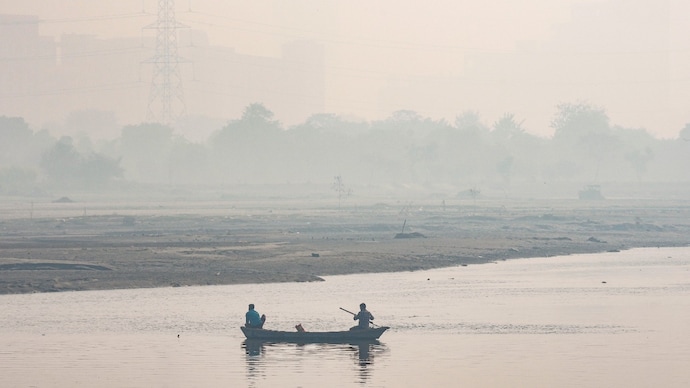
Delhi and its adjoining regions woke up to a thick layer of smog for the second consecutive day, as the Air Quality Index (AQI) remained lodged in the ‘severe’ category. The national capital recorded an overall AQI of 428, marking the worst pollution levels of the season so far. The choking haze has disrupted daily life, triggered health warnings, and forced authorities to extend emergency anti-pollution measures across the Delhi-NCR region.
Worst Air Quality of the Season
According to data from the Central Pollution Control Board (CPCB), Delhi’s AQI crossed the 400-mark late Tuesday evening and has shown no signs of improvement. Areas such as Anand Vihar, Mundka, RK Puram, and Jahangirpuri recorded AQI levels between 430 and 460, while neighboring cities like Noida, Gurugram, and Ghaziabad also fell under the ‘severe’ category.
Meteorological officials attribute the situation to a combination of low wind speed, falling temperatures, and stubble burning in neighboring states. The calm weather conditions have trapped pollutants close to the surface, preventing dispersion and leading to a dense, smoky haze across the city skyline.
Schools, Construction, and Traffic Affected
The worsening air quality has led to disruptions in daily life. Several schools in Delhi and Noida have suspended outdoor activities, while some have shifted to online classes for younger students. Authorities have also reimposed Stage III of the Graded Response Action Plan (GRAP), which includes restrictions on construction work, use of diesel generators, and entry of old commercial vehicles into the city.
Traffic congestion has worsened due to reduced visibility during morning and evening hours. Commuters reported difficulty navigating through fog-like conditions, with visibility dropping below 200 meters in several parts of Delhi and Gurugram.
bizkeyaccess.com | acebizpro.com | zipbizhub.com
biz-connector.com | primebizworld.com
Health Concerns Escalate
Doctors have warned that the persistent smog poses serious health risks, especially for children, the elderly, and individuals with pre-existing respiratory or cardiac issues. Hospitals have reported a surge in patients complaining of breathing problems, irritation in eyes and throat, cough, and fatigue.
Dr. Arvind Kumar, a lung specialist at Medanta Hospital, said:
“The level of particulate matter in the air is dangerously high. Long-term exposure to this can lead to irreversible lung damage, even among healthy adults. It’s important to stay indoors as much as possible and use air purifiers if available.”
Experts say the concentration of PM2.5 particles—tiny pollutants that can penetrate deep into the lungs—has crossed 10 times the safe limit prescribed by the World Health Organization (WHO).
Causes Behind the Pollution Spike
While Delhi’s poor air quality is a recurring seasonal crisis, this year’s spike has been particularly sharp. Environmental analysts point to three primary causes:
-
Stubble Burning: The largest contributor continues to be the burning of crop residue in Punjab and Haryana. Despite bans and awareness campaigns, satellite data from ISRO shows over 2,800 active fire spots across these states this week.
-
Vehicular Emissions: With more than 11 million registered vehicles, Delhi’s road emissions contribute nearly 40% of local PM2.5 levels.
-
Weather Conditions: Low wind speeds and temperature inversion during early winter trap pollutants near the ground, leading to smog formation.
Government Response: GRAP-3 Restrictions in Force
Following the steep rise in pollution levels, the Commission for Air Quality Management (CAQM) has enforced GRAP Stage 3 measures across Delhi-NCR. These include:
-
Ban on non-essential construction and demolition activities.
-
Closure of stone crushers, mining operations, and hot mix plants.
-
Prohibition of diesel generator sets (except for essential services).
-
Encouragement of remote work and carpooling.
If the situation worsens further, authorities may invoke Stage 4, which could include school closures, vehicle bans, and curbs on entry of trucks into Delhi.
Delhi Environment Minister Gopal Rai said on Wednesday,
“We are in constant touch with the CAQM and the neighbouring states. Our teams are conducting on-ground inspections to ensure compliance with pollution control measures. Citizens must cooperate by reducing private vehicle use and avoiding open burning.”
Political Blame Game Resumes
As air quality plummets, political parties have resumed their annual blame exchange. The Aam Aadmi Party (AAP) government in Delhi has accused the BJP-ruled states of Haryana and Punjab of failing to control stubble burning, while opposition leaders have criticized AAP’s odd-even vehicle policy and smog tower projects as “ineffective showpieces.”
BJP spokesperson Harish Khurana stated,
“Every year Delhi suffers, and every year the AAP government blames others. Where are the long-term solutions they promised?”
Environmentalists, however, emphasize that air pollution is a regional problem, not confined to Delhi alone. “Finger-pointing won’t help,” said environmental activist Sunita Narain. “We need coordinated regional action involving all NCR states.”
Residents Struggle Amid Toxic Air
Meanwhile, residents are battling daily struggles against the hazardous air. Many report headaches, fatigue, and sleeplessness due to polluted indoor conditions. Air purifier sales have surged, and demand for N95 masks has spiked in local pharmacies.
College student Neha Arora, who commutes from Ghaziabad to Delhi University, said:
“Every morning feels like walking through smoke. My throat burns, and my eyes keep watering. The government should at least ensure public transport is running efficiently so we don’t have to use cars.”
Experts Call for Long-Term Solutions
Air quality experts and environmental organizations have long argued that Delhi’s pollution crisis cannot be solved with short-term emergency measures. Instead, they call for a year-round clean air action plan that addresses root causes such as:
-
Transition to cleaner fuels and electric mobility.
-
Massive investment in public transport infrastructure.
-
Incentives for farmers to adopt residue management technologies.
-
Strengthening of industrial emission standards.
Dr. Vibha Dhawan, Director General of TERI, noted,
“We’ve made progress in monitoring and forecasting, but implementation remains weak. Without strict enforcement and long-term behavioural change, every winter will bring the same crisis.”
Forecast: Little Relief Ahead
According to the India Meteorological Department (IMD), weather conditions are unlikely to improve significantly for the next 3–4 days. Light winds and temperature drops are expected to keep pollution levels elevated until a western disturbance changes the wind pattern later this week.
Meteorologist R.K. Jenamani said,
“There is no major wind activity predicted in the coming days. The smog layer will persist until there’s a shift in wind direction or rainfall.”
Conclusion
As smog continues to choke Delhi-NCR, the city finds itself at yet another crossroads — torn between short-term firefighting and the urgent need for structural change. With every passing winter, the crisis deepens, reminding policymakers that clean air cannot wait for another season. For now, residents must navigate the toxic haze, hoping for winds of change — quite literally — to bring relief.
