
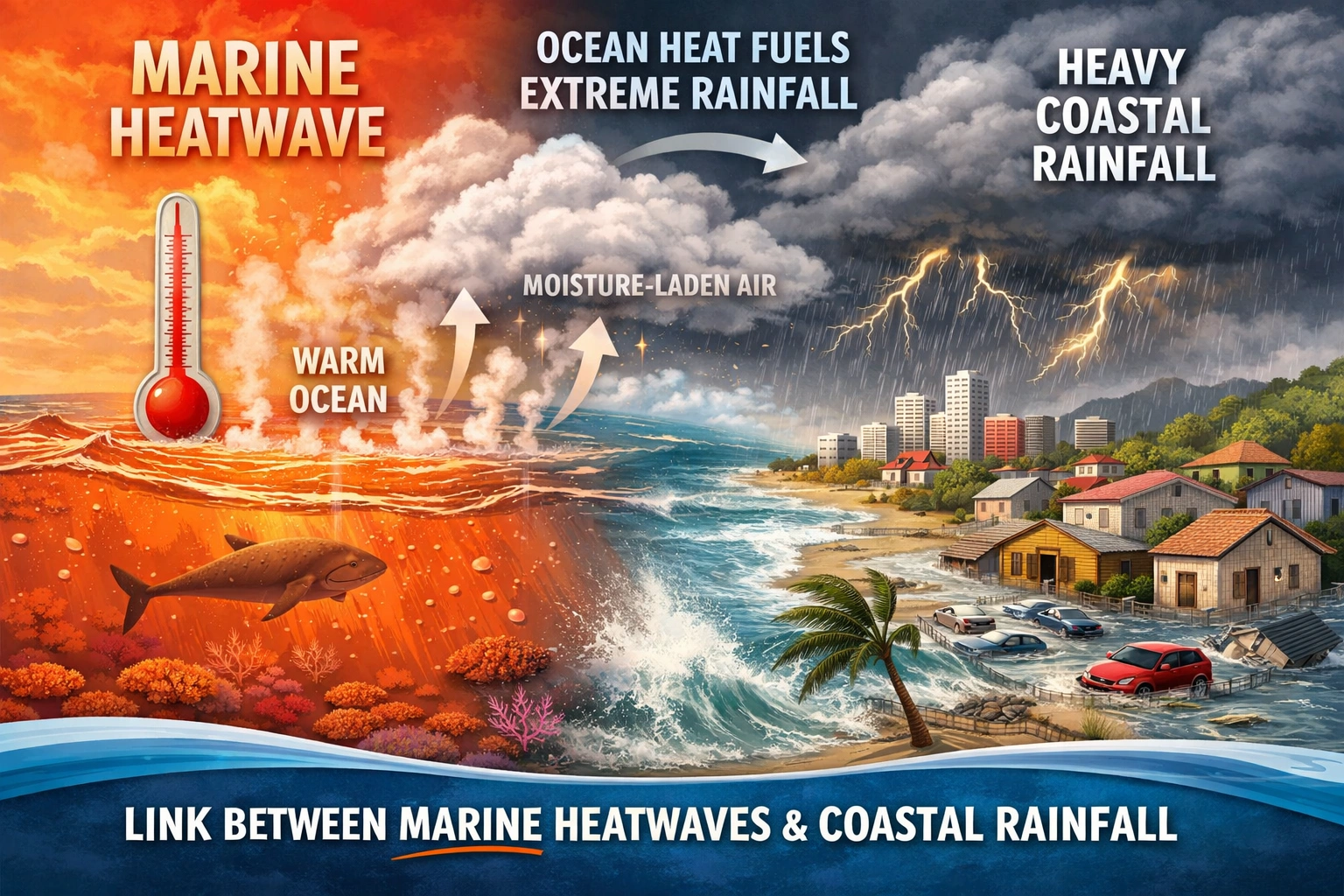
Climate change is often discussed in terms of rising air temperatures and extreme weather on land. However, a less visible but equally critical phenomenon is unfolding in the world’s oceans. Marine heatwaves—periods of unusually high ocean temperatures—are increasingly influencing weather patterns, particularly in coastal regions. Recent scientific findings suggest that between 1982 and 2022, approximately 5% to 25% of extreme rainfall events in coastal areas occurred shortly after nearby marine heatwaves. This growing connection highlights the ocean’s powerful role in shaping climate and weather systems.
Table of Contents
ToggleWhat Are Marine Heatwaves?
Marine heatwaves refer to prolonged periods during which sea surface temperatures rise significantly above average levels. These events can last from several days to months and are becoming more frequent due to global warming.
Unlike land-based heatwaves, which are immediately noticeable, marine heatwaves often go undetected by the general public. However, their impact on marine ecosystems and weather systems can be profound. Warmer oceans store more energy, which can later be released into the atmosphere.
This excess heat plays a crucial role in altering atmospheric conditions, ultimately influencing rainfall patterns, especially in regions close to coastlines.
Explanation:
This section defines marine heatwaves and explains how they differ from land heatwaves. It highlights their increasing frequency and their ability to store and release heat into the atmosphere.
How Ocean Heat Fuels Intense Rainfall
Warm ocean water increases the rate of evaporation, adding more moisture to the air. When this moisture-laden air rises and cools, it condenses into clouds, often resulting in heavy rainfall.
Marine heatwaves amplify this process by significantly raising sea surface temperatures. The warmer the ocean, the more moisture is available in the atmosphere, increasing the likelihood of intense and sudden rainfall events.
This mechanism explains why coastal regions often experience heavy downpours following periods of elevated ocean temperatures. The ocean essentially acts as a fuel source for extreme weather.
Explanation:
This section explains the scientific process linking ocean heat to rainfall. It focuses on evaporation, moisture buildup, and cloud formation as key drivers of heavy rain.
Evidence from Recent Climate Studies
Scientific research analyzing four decades of data has revealed a clear connection between marine heatwaves and extreme rainfall. Between 1982 and 2022, a significant percentage of coastal rainfall events occurred shortly after ocean temperatures spiked.
This data underscores the importance of considering ocean conditions when predicting weather patterns. It also highlights how interconnected Earth’s systems are, with changes in one domain influencing outcomes in another.
Such findings are crucial for improving climate models and forecasting systems, particularly for regions vulnerable to extreme weather.
Explanation:
This section presents the key findings from long-term studies. It emphasizes the statistical link between marine heatwaves and coastal rainfall events.
Why Coastal Regions Are More Vulnerable
Coastal areas are uniquely positioned at the interface between land and ocean, making them particularly sensitive to changes in sea conditions. When marine heatwaves occur nearby, the effects are felt almost immediately onshore.
Increased moisture in the air can lead to sudden and intense rainfall, which may overwhelm drainage systems and cause flooding. Urban coastal regions are especially at risk due to high population density and infrastructure limitations.
Additionally, rising sea levels can exacerbate the impact of heavy rainfall, leading to compound flooding events that are more difficult to manage.
Explanation:
This section explains why coastal regions are more affected. It highlights geographical factors, urban challenges, and the added risk of flooding.
Impact on Communities and Infrastructure
The consequences of intense rainfall triggered by marine heatwaves can be severe. Flooding can damage homes, disrupt transportation, and impact livelihoods, particularly in low-lying coastal areas.
Agriculture can also be affected, as excessive rainfall may lead to crop damage and soil erosion. In extreme cases, such events can result in displacement and economic losses.
Communities that rely on predictable weather patterns may find it increasingly difficult to adapt as these events become more frequent and intense.
Explanation:
This section focuses on the real-world impacts of heavy rainfall. It explains how communities, infrastructure, and economies are affected.
The Role of Climate Change
Climate change is a major driver behind the increasing frequency and intensity of marine heatwaves. As global temperatures rise, oceans absorb a significant portion of the excess heat.
This warming not only affects marine ecosystems but also enhances the processes that lead to extreme weather events. The link between ocean heat and rainfall is becoming more pronounced as the climate continues to change.
Understanding this relationship is essential for developing effective strategies to mitigate and adapt to these impacts.
Explanation:
This section connects marine heatwaves to climate change. It explains how rising global temperatures contribute to ocean warming and extreme weather.
Improving Forecasting and Preparedness
Recognizing the link between marine heatwaves and coastal rainfall can significantly improve weather forecasting. By monitoring ocean temperatures, scientists can better predict the likelihood of extreme rainfall events.
This information can help governments and local authorities prepare for potential disasters, reducing the risk to lives and property. Early warning systems can be enhanced to account for ocean conditions.
Improved forecasting also allows for better planning in sectors such as agriculture, urban development, and disaster management.
Explanation:
This section highlights the importance of forecasting. It explains how better understanding can lead to improved preparedness and risk reduction.
Adapting to a Changing Climate
As marine heatwaves become more common, adaptation strategies will be crucial. Coastal cities may need to invest in stronger infrastructure, improved drainage systems, and flood defenses.
Community awareness and education are also important, helping people understand the risks and take appropriate precautions. Sustainable urban planning can play a key role in reducing vulnerability.
Efforts to reduce greenhouse gas emissions remain essential in addressing the root cause of climate change and its associated impacts.
Explanation:
This section discusses adaptation strategies. It focuses on infrastructure, awareness, and long-term solutions to manage climate risks.
Conclusion: The Ocean’s Hidden Influence on Weather
The connection between marine heatwaves and intense coastal rainfall reveals the ocean’s powerful influence on our climate system. What happens beneath the surface of the sea can have far-reaching consequences for people living on land.
As scientific understanding grows, it becomes increasingly clear that addressing climate challenges requires a holistic approach that considers both land and ocean processes.
By recognizing and responding to these interconnected dynamics, societies can better prepare for the changing patterns of weather and build resilience against future climate impacts.
thedigitshub.com thedigitshub.com thedigitshub.com thedigitshub.com thedigitshub.com thedigitshub.com thedigitshub.com thedigitshub.com thedigitshub.com thedigitshub.com thedigitshub.com thedigitshub.com thedigitshub.com thedigitshub.com thedigitshub.com thedigitshub.com thedigitshub.com thedigitshub.com thedigitshub.com thedigitshub.com thedigitshub.com thedigitshub.com thedigitshub.com thedigitshub.com thedigitshub.com thedigitshub.com thedigitshub.com thedigitshub.com thedigitshub.com thedigitshub.com thedigitshub.com thedigitshub.com thedigitshub.com thedigitshub.com thedigitshub.com thedigitshub.com thedigitshub.com thedigitshub.com thedigitshub.com thedigitshub.com thedigitshub.com thedigitshub.com thedigitshub.com thedigitshub.com thedigitshub.com thedigitshub.com thedigitshub.com thedigitshub.com thedigitshub.com thedigitshub.com thedigitshub.com thedigitshub.com thedigitshub.com thedigitshub.com thedigitshub.com thedigitshub.com thedigitshub.com thedigitshub.com thedigitshub.com thedigitshub.com thedigitshub.com thedigitshub.com thedigitshub.com thedigitshub.com thedigitshub.com thedigitshub.com thedigitshub.com thedigitshub.com thedigitshub.com thedigitshub.com thedigitshub.com thedigitshub.com thedigitshub.com thedigitshub.com thedigitshub.com thedigitshub.com thedigitshub.com thedigitshub.com thedigitshub.com thedigitshub.com thedigitshub.com thedigitshub.com thedigitshub.com thedigitshub.com thedigitshub.com thedigitshub.com thedigitshub.com thedigitshub.com thedigitshub.com thedigitshub.com thedigitshub.com thedigitshub.com thedigitshub.com thedigitshub.com thedigitshub.com thedigitshub.com thedigitshub.com thedigitshub.com thedigitshub.com thedigitshub.com thedigitshub.com thedigitshub.com thedigitshub.com thedigitshub.com thedigitshub.com thedigitshub.com thedigitshub.com thedigitshub.com thedigitshub.com thedigitshub.com thedigitshub.com thedigitshub.com thedigitshub.com thedigitshub.com thedigitshub.com thedigitshub.com thedigitshub.com thedigitshub.com thedigitshub.com thedigitshub.com thedigitshub.com thedigitshub.com thedigitshub.com thedigitshub.com thedigitshub.com thedigitshub.com thedigitshub.com thedigitshub.com thedigitshub.com thedigitshub.com thedigitshub.com thedigitshub.com thedigitshub.com thedigitshub.com thedigitshub.com thedigitshub.com thedigitshub.com thedigitshub.com thedigitshub.com thedigitshub.com thedigitshub.com thedigitshub.com thedigitshub.com thedigitshub.com thedigitshub.com thedigitshub.com thedigitshub.com thedigitshub.com thedigitshub.com thedigitshub.com thedigitshub.com thedigitshub.com thedigitshub.com thedigitshub.com thedigitshub.com thedigitshub.com thedigitshub.com thedigitshub.com thedigitshub.com thedigitshub.com thedigitshub.com thedigitshub.com thedigitshub.com thedigitshub.com thedigitshub.com thedigitshub.com thedigitshub.com